AI Engineer & Researcher

Jahnvi
Paliwal

Intern @ VLED Lab, IIT Ropar . B.Tech CSE · 2027

I build things where code meets intelligence. I work across AI and software engineering, from training and improving ML models to building AI agents and integrating them into full-stack web applications. I’m comfortable handling frontend, backend, and databases, and I enjoy turning complex ideas into clean, usable products. If it involves smart systems, solid engineering, and actually shipping something real, count me in.

ML
Time Series Analysis . Cross Domian ML Applications
AI
RAG . LLM's . Prompt Engineering . LangChain . LangGraph
CV
Human Pose Esitation . Qbject Recognition . 3D Object Coordinate Systems . YOLO
12 Major Projects 3 Internships +15 Certificates Research HackerRank Golden Batch Bertsmann's Scholar

Work Experience

03
May 2026 — Present
FullStack + AI Developer: Intern
Vicharanshala Lab (VLED) · IIT Ropar, Punjab
  • Assisted in development of face-detection-based attendance and engagement monitoring pipelines.
  • Contributing to automation of scoring and behavioral monitoring workflows within an AI-integrated EdTech system.
  • Collaborating across a MERN-stack codebase, integrating computer vision inference modules with web-based deployment interfaces as part of a collaborative research team.
Node.js MongoDB React Computer Vision RAG, AI Agents Ed-Tech solutions Agri-Tech solutions Machine Learning, Python
May 2025 — Nov 2025
AI Developer Intern
BPaaS Proceedit · Barcelona, Spain (Remote)
  • Developed forecasting pipelines on daily financial time-series data (2010–2025), extracting seasonal, lag-based, andtemporal features to capture long-term behavioral patterns.
  • Engineered novel ML/Deep Learning ensemble architectures achieving 98.7% accuracy, substantially outperforming single-model baselines on financial forecasting tasks.
  • Integrated predictive models via GraphQL API, enabling 50% workload redistribution across compute layers and reducing operational server costs significantly.
  • Conducted extensive research into advanced asset-forecasting algorithms — including CatBoost, XGBoost, custom ResNet sandwich architectures, and peak-focused neural networks — evaluating accuracy vs. computational trade-offs for production deployment.
CatBoost XGBoost Financial Reinforcement Classification and Regression LSTM + ResNet GraphQL API Time-Series ML Python
Apr 2025 — Jun 2025
AI Developer Intern
CollegeTips.in · Mumbai, India (Remote)
  • Developed a production-grade multilingual AI chatbot with voice I/O, backend integration (FastAPI + PostgreSQL), and live deployment.
  • Designed multiple front-end web interfaces using React and Flask; one interface was adopted directly for production use by the organization.
  • Worked on LLM-driven existing chatbot using Groq LLaMA, generating context-aware responses in HindiEnglish, and Hinglish for the DiggiBuddy elderly-support initiative.
FastAPI PostgreSQL React Flask Ollama Groq Google Speech to text Services Multilingual NLP
Nov — Dec 2024
Software Engineering Intern
Marvik Academy (MATE) · Udaipur, India (On-site)
  • Built a Flutter notes application with persistent local storage (SQLite) and custom productivity features — the app was adopted by staff and distributed to students institution-wide.
Flutter Dart SQLite Mobile Dev

Featured Projects

12
2026
Interactive Hardware-Aware · Deep learning
NeuraLens
ML and hardware engineers have no single resource that bridges mathematical intuition, live computation, and silicon-level hardware analysis for deep learning layers. Textbooks give static equations. Playgrounds have no hardware context. FPGA guides have no ML intuition. Everything is scattered.
An interactive, single-file educational web application for exploring, visualizing, and understanding deep learning layers with real-time hardware analysis, live visualizations, and multi-level learning content designed for ML engineers, AI researchers, and hardware architects.
68+
Layers
12
categories
HTML5 Canvas APIVanilla JavaScript ES2020+
2026
Machine Learning · Customer Management
ShieldGraph
E-commerce platforms lose millions in logistics costs to organized Return-to-Origin (RTO) fraud rings placing malicious, anonymous Cash-on-Delivery orders with zero intent to pay.
I built a hybrid GNN and Transformer model that uncovers coordinated fraud rings via shared technical infrastructure and behavioral click-streams in under 10 milliseconds. The system intercepts live checkouts to dynamically disable Cash-on-Delivery for risky accounts, forcing digital prepayment to break the fraud ring's financial incentives.
Real-Time APIsGraph AnalyticsPyTorch Geometric (PyG)Graph Neural Networks (GNN)
2026
Machine Learning · Credit Risk
CreditRisk AI
Banks lose money when 21.8% of borrowers default on loans. Traditional credit scoring fails for MSMEs and individuals with no credit history, and manual underwriting is slow and inconsistent.
Built an XGBoost model that analyzes 10 features from loan applications (income, loan amount, interest rate, credit grade, employment history) to predict probability of default. The model approves safe borrowers (PD < 30%), reviews moderate risk (30-50%), and rejects high risk (> 50%), while providing top 3 reasons for each decision using SHAP values for regulatory compliance. Deployed as FastAPI REST endpoint with Docker containerization.
0.924
AUC Score
>92%
Precision
XGBoostSHAPPython
2026
Machine Learning . AgriTech. Open Source
Groundwater Depletion Risk Prediction in India
India's agriculture relies heavily on groundwater, yet increasing extraction, irregular rainfall, and growing water demand are causing aquifers in many regions to deplete faster than they can naturally recharge. This threatens crop productivity, farmer incomes, rural water security, and the long-term sustainability of agricultural communities.
This project successfully developed a machine learning model to predict groundwater depletion risk in Indian agricultural regions.Haryana village demonstration, where extraction (7.5 BCM) exceeded the extractable resource (6.0 BCM) and the model correctly predicted High Risk, validated the system’s utility as a budgeting and early-warning tool for smallholder farmers.
+95%
Accuracy
0.93–0.98 F1 Scores
Across all 3 classes
NumPyXGBoostPythonSeabornscikit-learn
2026
Agentic AI · Data Analytics
Product Performance Retrieval Agent
Raw financial CSV datasets are opaque to non-technical stakeholders — critical insights buried in numbers with no pathway to automated reasoning or visualization.
Built a modular LLM-driven pipeline: a dataset profiler extracts metadata (types, cardinality, distributions), feeds a Groq LLaMA 3.1 reasoning layer that dynamically suggests 6 tailored insights, then routes them to deterministic Python analysis functions. Results are auto-visualized via Streamlit, scored for data quality, and made queryable through interactive follow-up Q&A.
6
Auto Insights
LLaMA
3.1
Reasoning Core
LLaMA 3.1Groq APIStreamlitPandasRAG
2026
RAG · Data Analytics
Legal Document Intelligence System
Raw financial CSV datasets are opaque to non-technical stakeholders — critical insights buried in numbers with no pathway to automated reasoning or visualization.
Developed RAG-based pipelines to process large legal PDFs with structured retrieval workflows. Implemented chunking, embedding, and similarity search to improve response accuracy and optimized retrieval logic to support multi-document reasoning tasks.
FAISS
Storage
RAG
Context
LLaMA 3.1Groq APILangChaiPandasRAG
2026
Reasoning AI · Graph
Semantic Diffing for Evolving Knowledge Graphs
Raw financial CSV datasets are opaque to non-technical stakeholders — critical insights buried in numbers with no pathway to automated reasoning or visualization.
Built LLM-powered knowledge extraction pipelines generating temporal graphs from legal datasets. Engineered semantic diffing logic to detect contradictions across evolving documents and enabled fast entity-relation reasoning across large datasets.
Neo4j
LLM
LLaMA
3.1
Reasoning Core
LLaMA 3.1Groq APIStreamlitPandasRAG
2024
Computer Vision · Safety AI
Intelligent Brawl Monitor
Violence escalates without early warning, limiting timely intervention across public safety, workplace security, and women's safety scenarios.
Real-time video analytics pipeline using OpenCV for frame capture. CNN-based emotion models detect anger-related expressions; pose estimation (MediaPipe/OpenPose) identifies aggressive body stances. Rule-based fusion logic fires alerts only when both signals align — minimizing false positives. Automated email notification system for escalation.
Real-
time
Processing
Dual
Signal Fusion
OpenCVMediaPipeCNNTensorFlowEmail Alerts
2025
Computer Vision · Re-ID
Cross-Camera Human Identification System
Multi-camera human tracking in dynamic environments fails to maintain consistent identities across views without facial recognition — limiting surveillance scalability and privacy compliance.
View-invariant pipeline: YOLOv8 detects humans, BoT-SORT assigns per-camera track IDs, color histogram embeddings + temporal trajectory encoding enable cross-camera matching via Bhattacharyya distance & cosine similarity. Global ID map output as annotated MP4 per camera, original footage preserved.
YOLOv8
Detection
NVIDIA
T4
GPU Accelerated
YOLOv8BoT-SORTOpenCVCosine SimilarityNumPy
2025
NLP · Unsupervised ML
Cognitive Stress Analysis from Speech
Cognitive stress shapes speech patterns but is difficult to measure objectively without intrusive methods or labeled data.
End-to-end Python pipeline performing speech recognition, acoustic signal processing, and linguistic feature engineering to capture speech rate, pitch, pause patterns, hesitation markers, and sentence complexity. K-Means clustering + Isolation Forest anomaly detection + cosine similarity quantify and compare stress indicators. Auto-generates interpretable CSV reports.
Zero
Labels Required
5+
Feature Classes
librosaNLTKscikit-learnIsolation ForestK-Means
2025
Computer Vision · Research
Open-Vocabulary Object Detection Study
Traditional detection models are bound to predefined categories — evaluating zero-shot generalization and real-time speed vs. accuracy trade-offs across architectures remains an open challenge.
Side-by-side benchmark of OWL-ViT (zero-shot, text-query driven) vs. YOLOv8 on video feeds. Per-frame bounding box annotation, CSV-logged confidence scores, GPU-accelerated with mixed precision. Statistical analysis (T-tests, distribution plots) surfaces false-positive patterns and model divergence.
Zero-
shot
OWL-ViT
2-way
Model Comparison
OWL-ViTYOLOv8HuggingFacePyTorchSeaborn
2025
Full-Stack AI · Healthcare
MediHelper
Reliable preliminary skin disease identification and healthcare cost estimation are hard to access — leading to delayed diagnosis and poor financial planning for patients.
Full-stack Django web application integrating two ML models: a CNN trained on skin condition datasets (vitiligo, acne, SJS, hyperpigmentation, nail psoriasis) for image-based disease detection, and a linear regression model for healthcare cost prediction from user-provided health parameters. Modular MVC architecture designed for extension (chatbot, medicine scanning).
5
Conditions Detected
2
AI Models
DjangoTensorFlowCNNLinear RegressionPandas

Skills & Stack

Languages
  • Python
  • Java
  • C / C++
  • Golang
  • HTML · CSS · JS
  • Dart
ML / AI
  • Machine Learning
  • Deep Learning
  • NLP
  • RAG & Agentic AI
  • LLMs (Groq, OpenAI)
  • CNNs
Frameworks & Tools
  • Django · Flask · FastAPI
  • TensorFlow · Keras
  • Scikit-learn
  • Docker
  • Git · Linux
  • OpenCV · MediaPipe
Databases & APIs
  • PostgreSQL
  • MongoDB
  • SQLite · SQL
  • Pandas · NumPy
  • REST & GraphQL
  • LaTeX

Certifications & Credentials

14
Kaggle ML Cert
View Certificate
Kaggle
Intro to Machine Learning
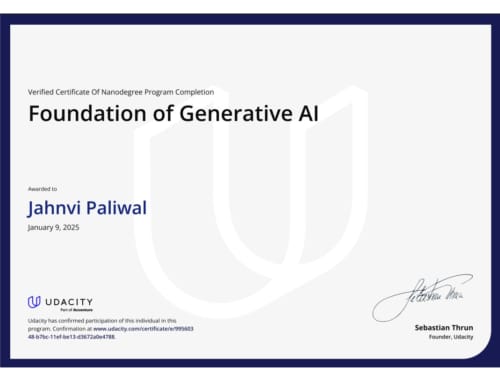
GenAI Cert
View Certificate
Udacity
Foundation of Gen AI
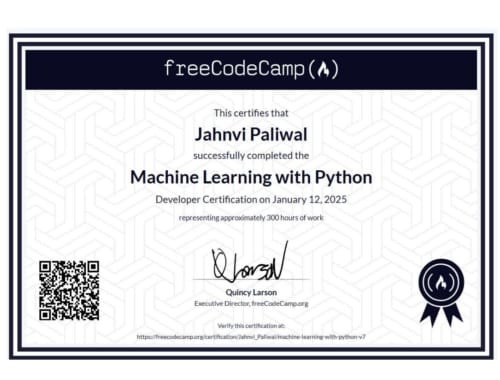
FCC ML Cert
View Certificate
FreeCodeCamp
Machine Learning with Python
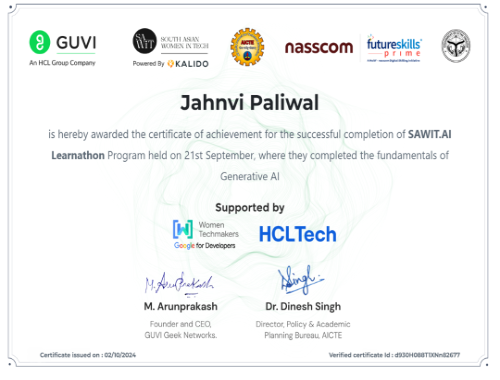
GUVI GenAI Cert
View Certificate
GUVI
Fundamentals of Generative AI
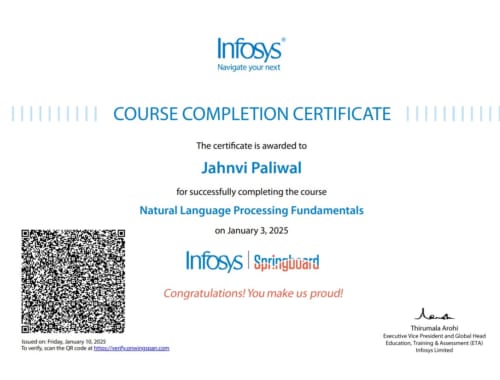
NLP Cert
View Certificate
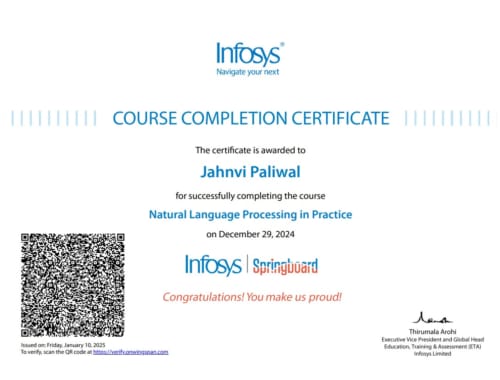
Infosys
NLP Fundamentals
NLP Practice Cert
View Certificate
Infosys
NLP in Practice
Design Thinking Cert
View Certificate
Infosys
Design Thinking
Python Cert
View Certificate
HackerRank
Python Basic
Java Cert
View Certificate
HackerRank
Java Basic
SQL Basic Cert
View Certificate
HackerRank
SQL Basic
SQL Intermediate Cert
View Certificate
HackerRank
SQL Intermediate
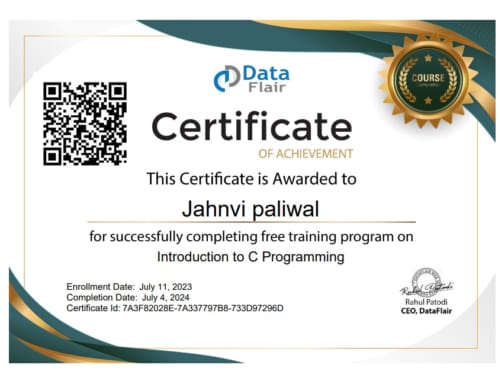
C Cert
View Certificate
DataFlair
Introduction to C Programming
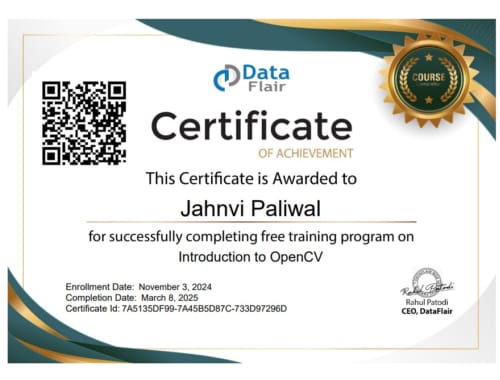
OpenCV Cert
View Certificate
DataFlair
Introduction to OpenCV
Oracle Cert
View Certificate
Oracle
OCI Foundation Associate

Research Investigations

02
Active Research
Physics-Informed Machine Learning for Phase Retrieval in Nonlinear Wave Propagation
Phase retrieval is a fundamental inverse problem in nonlinear optics — detectors measure only intensity, while the phase of a wave remains unobservable. Traditional algorithms fail in nonlinear media due to strong coupling between phase and intensity. This work addresses the problem through a physics-informed ML framework that unifies deep learning with NLSE-based physical constraints.
Generated synthetic training data using the split-step Fourier method, simulating intensity profiles at multiple propagation distances.
Designed and trained a multilayer perceptron predicting phase at a secondary plane from two intensity measurements.
Incorporated a physics-based regularizer derived from the 1D nonlinear Schrödinger equation (NLSE) to enforce physical consistency.
Applied Monte Carlo dropout during inference for predictive uncertainty quantification in ambiguous regions.
Key Results
Near-perfect intensity reconstruction and low phase errors on in-distribution data — validated across propagation regimes.
Meaningful uncertainty estimates that correlate with prediction ambiguity — robustness demonstrated on out-of-distribution inputs.
Outperforms classical Gerchberg–Saxton algorithm in both accuracy and stability, validating physics-prior integration.
Methods
NLSE · Split-Step Fourier · MLP · Monte Carlo Dropout · Physics-informed Regularization
Ongoing
AI-Based Vulnerability Lifetime & Network Security Analysis under Post-Quantum Cryptography
This research investigates predicting vulnerability lifetimes and identifying security limitations of network nodes during the transition to post-quantum cryptography, specifically under CRYSTALS-Kyber conversion. The core challenge: no publicly available labeled datasets exist, requiring custom dataset construction.
Defined problem scope around vulnerability lifetime prediction and node-level security degradation behavior under cryptographic transition.
Designed structured dataset schema for security indicators and temporal risk features — custom datasets being constructed due to absence of public labeled data.
Developing multiple test cases to capture time-dependent and vulnerability-specific features across different network node roles.
Early observations show vulnerability patterns vary significantly across node roles; temporal features are critical for modeling security degradation.
Current Progress
Problem scope & dataset schema defined. Custom dataset construction underway — no public labeled data exists for this domain.
Test-case expansion ongoing. Preliminary modeling experiments to begin upon dataset stabilization.
Domain
Post-quantum cryptography · CRYSTALS-Kyber · Network security · ML-based risk modeling · Temporal feature engineering
Bachelor of Technology, Computer Science
Institute of Engineering and Technology · Mohanlal Sukhadiya University
Udaipur, Rajasthan · Jun 2023 – Jun 2027
7.7
CGPA

Let's Connect

Open to research collaborations, AI engineering roles, and meaningful conversations about intelligent systems.
Primary Email
paliwaljnv08@gmail.com
Location
Udaipur, Rajasthan, India
Status
Open to Opportunities